Home / Services / Circuit Breaker Replacement
CIRCUIT BREAKER REPLACEMENT — PLANT CITY, FL
Circuit Breaker Replacement in Plant City, FL
A breaker that trips constantly, won’t reset, or smells like it’s burning isn’t protecting anything anymore. We diagnose the real cause first — then replace exactly the breaker that’s failed, with the right type and rating for your panel.
Diagnosis first · Firm written price before work starts · Most replacements done the same visit
What Does Circuit Breaker Replacement Cost in Plant City, FL?
Typical range: most single-breaker replacements in the Plant City area fall between $150 and $300, parts and labor — a typical market range, not a quote. Double-pole breakers (dryers, AC units, water heaters) usually run $200–$450; a main breaker replacement typically runs $350–$650 because it involves coordinating a power disconnect. The breaker itself is often a $15–$40 part — you’re paying for the diagnosis, the safe installation, and the testing that confirms the circuit is actually fixed. Your firm written price is confirmed before any work starts, after we’ve seen your panel.
7 Signs Your Circuit Breaker Needs Replacing
Not every tripping breaker is a bad breaker — but these signs point at the breaker itself, not the circuit:
It trips under light load. A single lamp and a phone charger shouldn’t trip a healthy 15-amp breaker. When a breaker trips with almost nothing running, its internal mechanism is worn out.
It won’t stay reset. You flip it back on and it trips again immediately, with nothing plugged in. That’s a failed breaker, not an overload.
Scorch marks or a burning smell at the panel. Discoloration around a breaker or a hot, acrid odor means heat damage or arcing. Don’t reset it again — call.
The breaker buzzes or feels hot. A healthy breaker is silent and room-temperature. Buzzing or heat means a failing internal connection.
It feels loose or doesn’t click firmly. A breaker should seat with a solid click. A loose breaker has a poor connection to the bus bar — a fire risk.
It’s more than 25–30 years old. Breakers are mechanical devices. After decades of heat cycles, the trip mechanism gets sluggish or seizes.
Your panel brand is Federal Pacific Stab-Lok or Zinsco. These breakers are the hazard themselves — they can fail to trip during a fault. We don’t just swap these; the panel replacement page needs a safety evaluation first.
Is It the Breaker, the Circuit, or the Whole Panel?
This is the diagnosis that matters — because each one has a completely different fix:
It’s probably the breaker when: the tripping is isolated to one breaker position, it happens under light load, or the breaker shows any of the physical signs above. Fix: replace that breaker.
It’s probably an overloaded circuit when: the breaker only trips when several high-draw appliances run together (microwave + AC, space heater + hair dryer), the pattern is tied to specific appliances, and every other breaker behaves normally. The breaker was doing its job correctly. Fix: usually a dedicated circuit for the heavy appliance — not a bigger breaker. (Putting a 20-amp breaker on 14-gauge wire rated for 15 amps is a code violation and a fire hazard.)
It’s probably the panel when: multiple breakers misbehave, you see corrosion across the bus bar, the panel is a Federal Pacific, Zinsco, or Challenger, or there’s simply no room left for the circuits your home needs. Fix: panel repair or full replacement.
We diagnose before we quote. If the breaker is fine and the circuit is overloaded, we’ll tell you — replacing a good breaker wouldn’t fix anything.
What a Breaker Replacement Actually Involves
1. Diagnosis. We test the breaker, the circuit load, and the connections. A breaker gets replaced only when the breaker is the problem.
2. Power down and isolate. The main breaker comes off; the circuit is verified dead before anyone touches it.
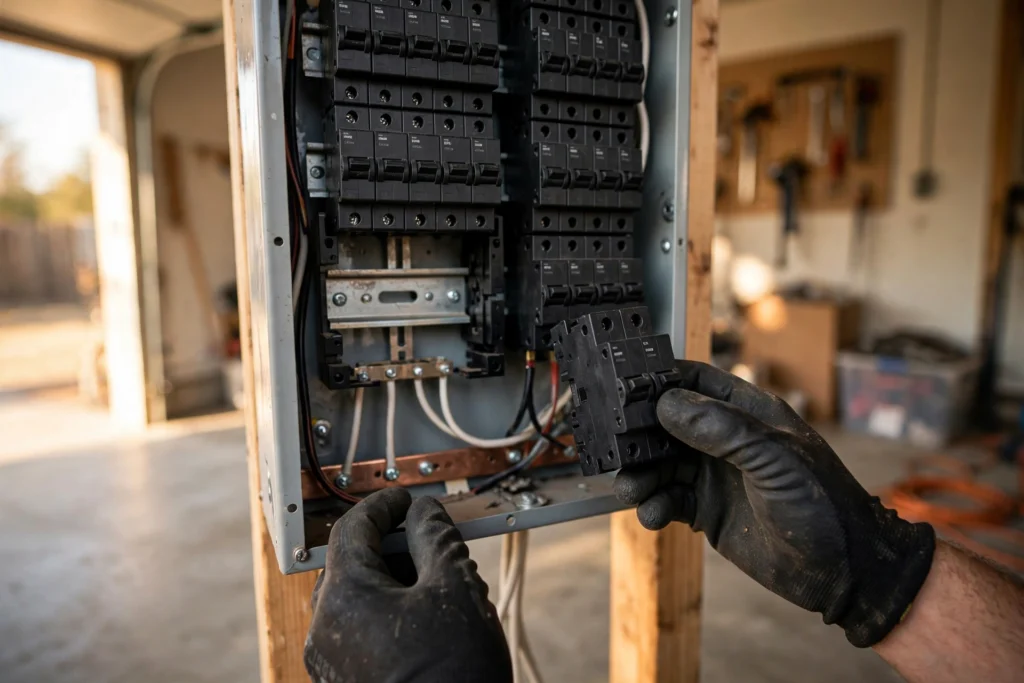
3. The right breaker, not just any breaker. The replacement must match your panel’s brand and type (breakers aren’t universal — a Siemens breaker doesn’t belong in a Square D panel), plus the correct amperage and type: standard, GFCI, AFCI, or double-pole. For most modern panels we install Square D QO or Eaton CH series breakers.
4. Seating and torque. The new breaker is seated firmly on the bus bar and connections are torqued to spec — loose connections are how panels overheat.
5. Load test and verify. Power back on, circuit loaded, breaker tested. You get a firm written price before any of this starts.
Most single-breaker replacements take under an hour once diagnosed. Main breaker replacements take longer because the power company must disconnect and reconnect the service.
Not sure what your breaker needs?
Call (813) 471-5214 — we’ll give you a firm number before any work starts.
Which Breaker Does Your Circuit Need?
Standard single-pole (15–20A): General lighting and outlet circuits. The most common replacement.
Double-pole (30–60A): 240-volt circuits — electric dryers, water heaters, ranges, AC condensers.
GFCI breakers: Required protection for kitchens, bathrooms, garages, and outdoor circuits — trips on ground faults that can electrocute.
AFCI breakers: Protect against arc faults that cause fires; required on most living-area circuits in modern code.
Main breaker (100–200A): The single disconnect for your whole home. Replacement involves the meter and utility coordination.
If your panel still uses screw-in fuses, that’s a different conversation — upgrading to a modern breaker panel is the safe move.
Plant City Factors That Affect Breakers
Florida humidity doesn’t spare the inside of a panel. In garage or exterior-mounted panels, moisture corrodes breaker contacts and bus bars over time — a breaker that looks fine can have green, crusty terminals underneath. After storm season, surge-damaged breakers are more common: a nearby lightning strike can weaken a breaker’s trip mechanism without tripping it, leaving it unreliable. And in older homes near Historic Downtown, original breakers from the 60s–80s are simply past their mechanical life. None of this means you need a new panel — it means the individual breaker deserves a look.
Circuit Breaker Replacement FAQs
How much does it cost to replace a circuit breaker in Plant City, FL? Typically $150–$300 for a standard single-pole breaker, parts and labor. Double-pole breakers run $200–$450; main breaker replacement is typically $350–$650. Your exact written price is confirmed after we see your panel.
Can I replace a circuit breaker myself? We don’t recommend it. Even with the main breaker off, the service lugs stay energized, and installing the wrong type or amperage creates a fire hazard. Florida requires a licensed electrician for panel work, and a permit is required in many cases.
How long does breaker replacement take? Most single breakers: under an hour, same visit. Double-pole: about the same. Main breaker: half a day or more, since the utility must disconnect and reconnect power.
Why does my breaker keep tripping after I reset it? Either the breaker itself has failed (trips under light load or won’t stay reset) or something on the circuit is overloading or shorting. Repeated resetting without diagnosis is how panels overheat — get it checked.
Should I just replace the whole panel instead? Only if the panel warrants it: Federal Pacific/Zinsco/Challenger brands, widespread corrosion, multiple failing breakers, or no room for needed circuits. If the panel is sound and one breaker failed, replacing the breaker is the honest fix.
Do you replace breakers in any brand of panel? We service all major residential brands — Square D, Eaton, Siemens, GE, Murray. For obsolete or recalled panels (Federal Pacific Stab-Lok, Zinsco), we’ll evaluate safety first rather than just swapping a breaker into a hazardous panel.
Serving Plant City and Surrounding Hillsborough County
We serve Plant City and surrounding Hillsborough County — Historic Downtown, Walden Lake, Magnolia Green, Varrea, Park Place, Country Hills, Trapnell, Turkey Creek.
One bad breaker can put your whole home at risk. Get it diagnosed right.
Call (813) 471-5214 — diagnosis first, firm written price, most replacements done the same visit.
Panel Repair · Panel Replacement · 200-Amp Upgrade · Services · FAQ · Contact