Home / Services / Panel Upgrade
ELECTRICAL PANEL UPGRADE — PLANT CITY, FL
Electrical Panel Upgrade in Plant City, FL
Your home wasn’t built for your life — EV chargers, home offices, modern appliances. We bring older electrical systems up to modern safety and code standards, with room for what’s next.
Safety assessment first · Code-compliant modernization · Firm written price before work starts
What Does an Electrical Panel Upgrade Cost in Plant City, FL?
Typical range: a full panel modernization in the Plant City area usually falls between $1,800 and $4,500 — a typical market range, not a quote. Where you land depends on scope: a straightforward panel modernization (new panel, updated grounding, modern breakers) runs $1,800–$3,500; adding a service amperage increase runs $2,500–$4,500; safety add-ons like whole-home surge protection add a few hundred more. Your firm written price is confirmed before any work starts, after we’ve assessed your current panel and your plans for the home.
7 Signs Your Home’s Electrical System Needs Upgrading
1. Your panel is 25+ years old. Panels last decades, but a 1980s-era panel was designed for a 1980s lifestyle — a fraction of today’s electrical demand.
2. You still have a fuse box. Screw-in fuses can’t provide the arc-fault and ground-fault protection modern code requires, and they’re incompatible with most new equipment.
3. Breakers trip across multiple circuits. One tripping breaker is a breaker problem. Breakers tripping all over the house is a system problem.
4. Two-prong outlets and no GFCI protection. Ungrounded outlets in kitchens, baths, and outdoor areas are a shock hazard modern code doesn’t allow.
5. An inspection or insurer flagged your panel. Federal Pacific, Zinsco, or Challenger panels get flagged on 4-point inspections — and many Florida insurers require them gone before they’ll write or renew a policy (check with your carrier; each insurer sets its own rules).
6. You’re planning something big. EV charger, addition, pool equipment, solar, or a whole-home generator — every one of these starts with the question “can your panel handle it?”
7. Flickering lights, warm panel cover, or buzzing. These are distress signals from an overloaded or deteriorating system. Don’t wait these out.
What “Upgrade” Actually Means: Three Paths
“Upgrade” covers three different projects — here’s how to tell which one you need:
Path 1 — Panel replacement (like-for-like modernization). Your amperage is fine, but the panel itself is outdated, damaged, or a hazardous brand. We swap it for a modern code-compliant panel. → Electrical Panel Replacement
Path 2 — Service upgrade (more power). Your home needs more amperage than the service provides — the classic 100-to-200-amp jump for EVs, additions, and all-electric homes. → 200-Amp Service Upgrade
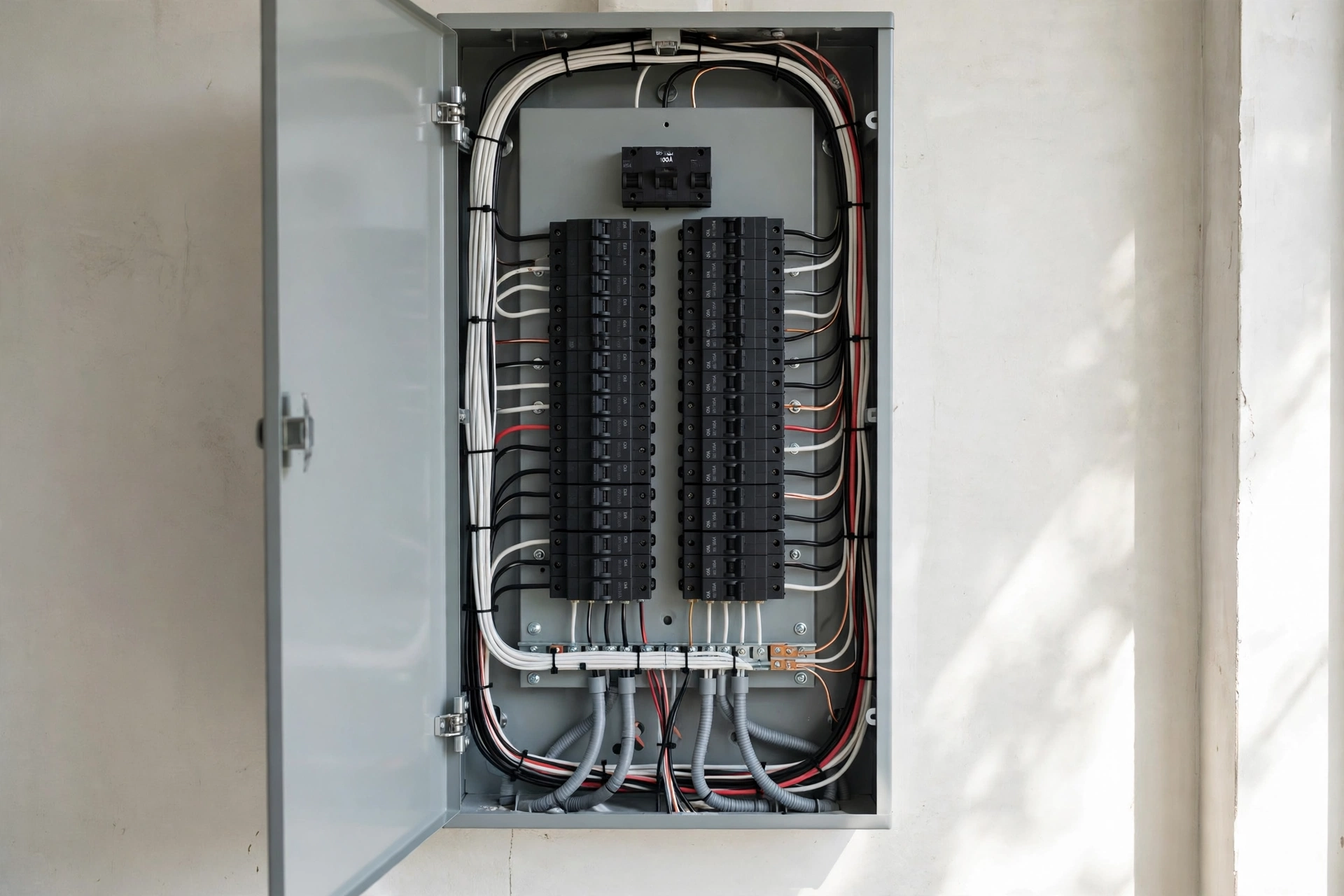
Path 3 — Safety and code modernization. The panel stays or gets replaced, and everything around it comes up to current standards: proper grounding and bonding, AFCI/GFCI protection where code requires it, whole-home surge protection, and every circuit clearly labeled.
Most older-home upgrades combine paths — a new 200-amp panel with full modern protection, permitted and inspected. Our assessment tells you which paths your home actually needs, instead of selling you all three.
The Modernization Checklist: What a Full Upgrade Includes
- New panel, properly sized — 200A for most modern homes, sized from a real load calculation (NEC Article 220), not a guess
- Grounding and bonding verified — per NEC Article 250; older Florida homes often have undersized or corroded grounding
- AFCI protection — guards against arc faults that cause fires; required on most living-area circuits in current code
- GFCI protection — kitchens, bathrooms, garages, outdoor circuits; the shock protection older homes lack
- Whole-home surge protection — Central Florida sees some of the most lightning in the country; a Type 2 device at the panel is inexpensive protection for everything downstream
- Labeled circuits and spare capacity — every breaker identified, plus open slots for the next decade of additions
Upgrades, Insurance, and 4-Point Inspections in Florida
Florida insurers can require a 4-point inspection on older homes, covering electrical alongside roof, plumbing, and HVAC. Federal Pacific Stab-Lok and Zinsco panels are the most common electrical reason policies get declined or conditioned on replacement — many carriers won’t write or renew until they’re gone. A documented, permitted panel upgrade with a clean inspection report is exactly what underwriters want to see. If your renewal is coming up, an upgrade now beats a scramble later.
What an Upgrade Project Actually Involves
1. Assessment. We inspect your panel’s age, brand, condition, and amperage — plus your plans (EV? addition? generator?). No upgrade gets recommended that your home doesn’t need.
2. Load calculation and plan. Your home’s actual demand gets calculated per NEC Article 220, and we map which of the three upgrade paths apply.
3. Permit pulled. Panel work in Plant City requires a city permit and inspection. We handle the paperwork and scheduling.
4. Installation day. Power off, old equipment out, new panel and protection in — most upgrades complete in a day; service increases involving the utility take coordination with TECO for disconnect and reconnect.
5. Inspection and close-out. The city inspector signs off, and you get the close-out paperwork — the same documentation your insurer wants.
Plant City Factors That Drive Upgrades
Historic Downtown and surrounding neighborhoods hold Plant City’s oldest housing stock — 1950s through 1980s homes where original fuse boxes and Federal Pacific panels are still common, and where 60-amp services were standard. These homes are prime candidates for full modernization, not piecemeal fixes. Meanwhile, newer subdivisions usually need upgrades for a different reason: capacity — the EV charger, the workshop, the pool equipment that the original 150A service wasn’t planned for.
Electrical Panel Upgrade FAQs
What’s the difference between a panel upgrade and a panel replacement?
Replacement swaps the panel box itself. An upgrade is the bigger picture — it can mean replacement, a service amperage increase, safety and code modernization, or all three. Our assessment identifies which your home needs.
How much does a panel upgrade cost in Plant City, FL?
Typically $1,800–$4,500 depending on scope — panel modernization at the lower end, service increases at the higher end. Your firm written price is confirmed after we assess your panel.
Will upgrading my panel lower my homeowners insurance?
It can help, especially if you’re replacing a flagged brand (Federal Pacific, Zinsco) that was blocking or conditioning your coverage. Some carriers offer credits for updated electrical; ask your agent what your carrier rewards.
Can I upgrade my panel in stages?
Sometimes. Safety-critical items (hazardous panel, failed grounding) shouldn’t wait, but capacity additions like a subpanel for a workshop can be phased. We’ll lay out a staged plan if your budget needs it.
Do I need a permit for a panel upgrade?
Yes. The Florida Building Code requires a permit for panel upgrades, and the City of Plant City inspects the work before close-out. We pull the permit and handle inspection scheduling.
How long does a panel upgrade take?
Most upgrades complete in one day (4–8 hours without power). Service amperage increases add utility coordination time — permits, TECO scheduling, and inspection typically stretch the total timeline to 1–3 weeks, with power out only on installation day.
Not sure which upgrade path your home needs?
Call (813) 471-5214 — we’ll assess your panel and give you a firm written price before any work starts.
Serving Plant City and Surrounding Hillsborough County
We serve Plant City and surrounding Hillsborough County — Historic Downtown, Walden Lake, Magnolia Green, Varrea, Park Place, Country Hills, Trapnell, Turkey Creek.
Bring your home’s electrical system into the modern era.
Call (813) 471-5214 — assessment first, firm written price, permit and inspection handled.
Panel Replacement · Panel Repair · 200-Amp Upgrade · Circuit Breaker Replacement · Subpanel Installation · Services · FAQ · Contact